
The 2027 Scientist Training Programme is expected to open for applications in January 2027, with the Situational Judgement Test a fortnight or so later. Last year 11,109 people applied for 389 posts. This guide covers how the process works, what the SJT looks like and how to prepare.
The STP is a three-year programme for science graduates who want to become Clinical Scientists in the NHS. You're employed by an NHS trust on a fixed-term contract at Agenda for Change Band 6, you rotate through departments in year one before specialising, and you complete a part-time MSc in Clinical Science alongside the job. The MSc is funded, and from this year each trainee also gets £2,137 a year towards the travel and accommodation costs of the academic side. Finish the programme and you can apply for HCPC registration as a Clinical Scientist.
It's run by the National School of Healthcare Science (NSHCS), part of NHS England. There are two routes in. Direct entry is for external applicants and is what this guide covers. In-service is for existing NHS staff nominated by their employer, and if that's you, the in-service guidance is the place to start.
The process has five stages, each with a status you'll see in Oriel:
- Application through Oriel
- Situational Judgement Test (the longlisting gate)
- Shortlisting by specialty panels
- Interview
- Offer, matched to your location choices
NSHCS says the 2027 round will "likely" open in January and that confirmed dates will be published when available. In the past two rounds they've appeared a few weeks before opening, so bookmark the applicants page and check it from December.
Key dates for 2027
NSHCS hasn't published the 2027 timeline yet. The 2026 round gives you a reliable shape to plan around, because the window is short and it falls at the same point every year.
How the 2026 round ran
- Applications opened: Tuesday 6 January 2026, 11am
- Applications closed: Monday 19 January 2026, 4pm (extended from 16 January)
- SJT window: 27 to 29 January 2026
- Longlist outcomes: 23 to 27 February 2026
- Shortlisting, sub-preferences and interviews: spring 2026
- Programme started: September 2026
What to expect for 2027
- Applications: expected to open in January 2027, dates to be confirmed [update when published]
- SJT: expected late January or February 2027 [update]
- Programme starts: September 2027
Two things to take from this. The application window is about two weeks, so if you wait until it opens to start writing, you've left yourself very little time. And the SJT follows within a fortnight of the deadline, so your test preparation needs to be done before January, not during it.
All published times are UK time. If you're applying from abroad, work out the difference before the deadline rather than after.
Step 1: Eligibility and the Oriel application
You need a first or 2:1 in an undergraduate honours degree or integrated master's in a science subject relevant to your chosen specialty. A 2:2 is acceptable if you also hold a relevant higher degree such as an MSc. Final-year students can apply on a predicted grade, but you'll need to prove you got it by the end of July or the offer is withdrawn. The full criteria are on the entry requirements page and they vary by specialty, so check yours specifically.
You apply through Oriel. Register early, because the account takes time to set up and you can't apply until the vacancy opens. Use a personal email address you'll still have access to in September, not a university one. And use a laptop or PC. The specialty preference is set by drag and drop, which doesn't work on a phone or tablet.
You can apply for one specialty only. Submit more than one application and you're disqualified from the whole round. If you're torn between two, the competition ratios further down are worth a look before you decide.
The part of the form that gets scored is the supporting information, three questions with a 500-word limit each. For 2026 they were:
- What is your motivation for applying to the STP, including your chosen specialty?
- What is your understanding of the role of a healthcare scientist within your chosen specialty?
- What skills and experience do you have that make you an ideal trainee clinical scientist? Include how your qualifications meet the STP entry criteria.
NSHCS recommends using the full 500 words on each. Shortlisters read these alongside your education section, but not your employment history, so if a job gave you relevant experience, say so in the answers rather than assuming they'll see it elsewhere. Don't include your name or anything identifiable.
One more thing, stated plainly on the NSHCS site: don't use AI to write your answers. Applications may be screened for it. Draft them yourself, in your own words, against the person specification.
Step 2: The Situational Judgement Test
Every direct-entry applicant sits the SJT, and it's the first cut. NSHCS applies a cut score, and anyone below it is marked "longlist unsuccessful" in Oriel and goes no further. Your application form isn't read until you've cleared this. So the SJT isn't one factor among several at this stage. It's the whole gate.
It also comes back later. At shortlisting, when two applications score the same, the SJT score is the tiebreaker.
You take it online, from home, through Pearson VUE, at any point in a three-day window. Pearson emails login details after applications close (sometimes username and password in separate emails, so check your junk folder). You'll need a Windows or Mac computer with a current browser and a stable broadband connection. Phones and tablets aren't supported, and Pearson recommends a wired connection over wifi. Before the test starts you'll accept a non-disclosure agreement. Decline it and your application stops.
Format
The test is 25 scenarios drawn from healthcare science settings, each with four to eight response options. You rate every option on a five-point scale from 1 (very appropriate) to 5 (very inappropriate), and you have 50 minutes from the first question. There's a flag-for-review button, a glossary for starred terms, and no negative marking, so answer everything.
The test was developed by the Work Psychology Group with healthcare scientists and maps to the person specification. It measures four attributes: empathy and compassion, professional integrity, team collaboration and adaptability. Answer keys were set by a panel of NSHCS subject matter experts, and you're scored on how close each rating is to theirs.
How to answer
The NSHCS guidance on this is specific and worth taking literally.
Rate each option on its own. An option doesn't need to fix the whole situation to be very appropriate. If a wrong result has gone to a patient, "ask the patient if they're OK" is still a very appropriate thing to do even though it's not the only thing.
Ratings can repeat within a scenario. If all six options are very appropriate, give them all a 1.
Ignore timing. An option that's right immediately and an option that's right a week later are both appropriate.
Answer as a trainee scientist should act, not as you might act in the moment. And don't hold out for the perfect option. The list isn't meant to be complete, and the response you'd actually choose may not be there. Judge what's in front of you.
The only reasonable adjustment available is 25% extra time, and you must request it on the Oriel form with evidence before you submit. Nothing can be added afterwards, and you must wait for the decision before starting the test.
You won't get a score or a confirmation email. Log back into Pearson, check Exam History shows "Delivery Successful", and wait for the longlist outcome in Oriel.
Steps 3 to 5: Shortlisting, interview and offers
Once you're longlisted, your application goes to a specialty-specific panel. They check your qualifications against the entry requirements and score the supporting information against the person specification. Shortlisted applications are ranked by that score, with the SJT breaking ties. Your Oriel status becomes shortlisted, shortlist reserve or shortlist unsuccessful.
If you're shortlisted there's a window to choose your sub-preferences, the locations and trusts you'd accept within your specialty. It has its own deadline. Miss it and you can't be allocated a post, so treat it like the application deadline.
Interview places depend on how many posts there are, and they're allocated by shortlist rank. Interviews are usually held online and focus on your motivation for the specialty, your understanding of what a healthcare scientist actually does day to day, professional judgement, and how you apply scientific reasoning to clinical and service problems. Interview scores are ranked against everyone in the specialty.
Offers run from rank one downwards and are matched to your location choices. If you answered yes to any fitness-to-practise question on the form, a panel reviews the declaration at this point before an offer is confirmed.
NSHCS has published videos from current trainees and a Training Programme Director on what shortlisters look for. They're linked at the bottom of the direct entry guidance and worth an hour of your time.
How competitive is it?
In 2026 there were 11,109 applications for 389 direct-entry posts in England, about 29 applicants per post. In 2025 it was 7,873 for 320 posts, so applications rose 41% in a year while posts rose 22%. (Totals are summed from the NSHCS specialty figures, published 8 October 2026.)
The overall ratio hides enormous variation between specialties, and since you can only apply to one, this matters.
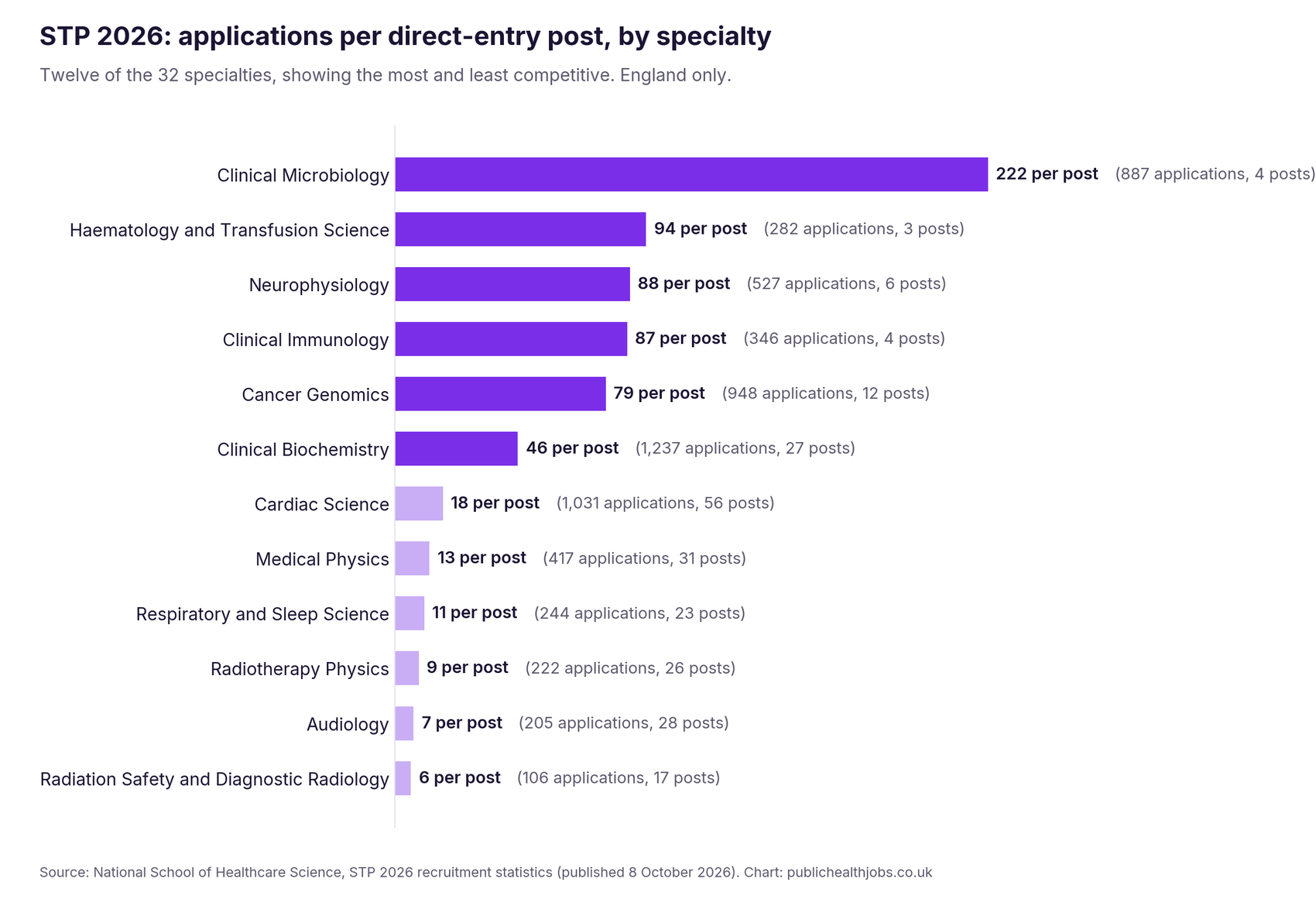 The life sciences specialties are the crowded end. Clinical Microbiology had 887 applicants chasing four posts. The physical sciences and physiological sciences are a different market: Radiation Safety had six applicants per post, Audiology seven, and Audiology also had the second-highest number of posts in the whole programme.
That's not a reason to apply for something you don't want to do for three years. But if you have a legitimate interest in two specialties and one of them has a ratio of 10 and the other 80, the choice isn't neutral. The full table for all 32 specialties is on the NSHCS site, with 2025 and earlier years alongside for comparison.
How to prepare
The application and the SJT need different kinds of preparation, and both need to be finished before January.
For the application, read the person specification and job description for your specialty, then draft your three 500-word answers in November or December. Get someone who knows the field to read them. The questions are published in advance, there's no excuse for writing them in the two-week window.
For the SJT, start with the official material. NSHCS and Pearson publish a sample test with worked rationales for each rating, and the NSHCS page on the SJT explains the four attributes being measured and how to approach each option. NSHCS warns that unofficial advice online can be inaccurate, and that's fair. Anything that teaches you to rank options against each other, for instance, is teaching you the wrong test.
What the official sample won't give you is volume. One sample test doesn't build the pace you need to rate 25 scenarios with up to eight options each in 50 minutes. That's what practice tests are for.
STP Practice is built specifically for the STP SJT: timed practice tests in the real 1-to-5 rating format, with explanations tied to the four NSHCS attributes so you learn why a response is somewhat appropriate rather than very appropriate. STP Practice is £24.99 for immediate access, or try a 5-question diagnostic test for free.
JobTestPrep's NHS STP SJT PrepPack is the main alternative, with two full-length simulations, study guides and score reports.
Neither is endorsed by NSHCS, and neither contains real test questions. Use them to build familiarity and speed, then go back to the official sample the week before the test to recalibrate against the real answer key.